
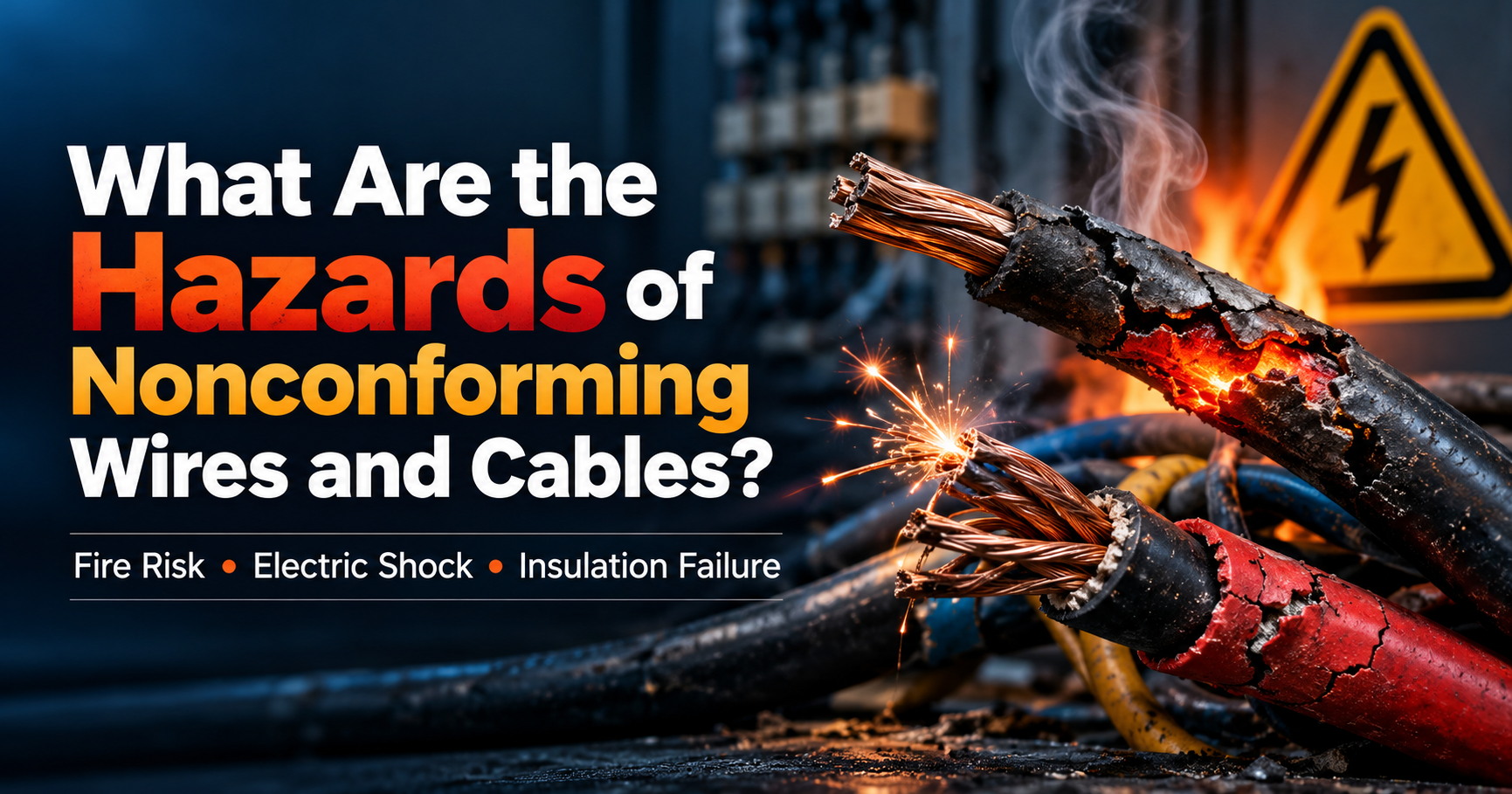
Wires and cables are a broad category of electrical products used to transmit electric power and information and to realize the conversion of electromagnetic energy. Wires and cables play an indispensable role in all economic activities and social life. It can be said that wherever people live, wherever production, transportation, and all kinds of economic activities take place, wires and cables are essential. Therefore, the quality of wires and cables directly affects our lives.
The main problems with nonconforming products lie in their structure, conductor dimensions, conductor resistance, and the tensile strength of insulation and sheaths before aging. When consumers use such products, they are highly susceptible to risks such as electrical leakage, electric shock, and even fire. These inferior products create numerous hidden hazards to the normal operation of the power system.
1. After a single-phase ground fault (short circuit) occurs in a wire or cable, if the protective relay fails to operate and cut off the fault, the wire or cable may overheat and cause its insulation layer to ignite spontaneously.
2. Wires and cables with sheath-type insulation whose tensile strength and elongation before aging meet the requirements. If the tensile strength and elongation of the insulation sheath before aging do not meet the requirements, the service life of the wire or cable is greatly shortened. Moreover, during installation or when continuously energized for a long time in a high-temperature environment, the insulation may easily crack, exposing the live conductor and creating a risk of electric shock or short circuit.
3. Wires with nonconforming conductor resistance. Conductor resistance is a key indicator used to assess whether the conductor material and cross-sectional area of a wire or cable meet the requirements. When conductor resistance exceeds the limit, losses as current flows through the line increase, intensifying heating of the wire or cable. The main reason for nonconforming conductor resistance is that, in order to reduce costs, which are 80% attributable to raw materials, companies skimp on copper: they either reduce the conductor’s cross-sectional area or use recycled copper with excessive impurities. This causes the conductor resistance of the wire or cable to substantially exceed the limit. During use, this not only makes fire more likely, but also accelerates the aging of the insulation layer covering the wire.
4. The insulation layer of a wire or cable gradually ages during normal operation, and its service life is generally 15–20 years. If a wire is frequently overloaded or subjected to overvoltage due to its service conditions, if the insulation layer is thinner than required, or if it is improperly installed (for example, the cable’s bending radius is too small or the conduit diameter is too small), an accident may result.
5. Wires and cables with nonconforming structural dimensions. The main issues with structural dimensions concern sheath thickness and insulation thickness. If the sheath and insulation of a cable are thinner than required, its electrical withstand strength is significantly reduced, shortening the service life of the wire or cable. In severe cases, the wire or cable may be punctured, and the insulation (sheath) layer may fail to provide its normal protection, resulting in electrical short circuits, fires, and other incidents.