
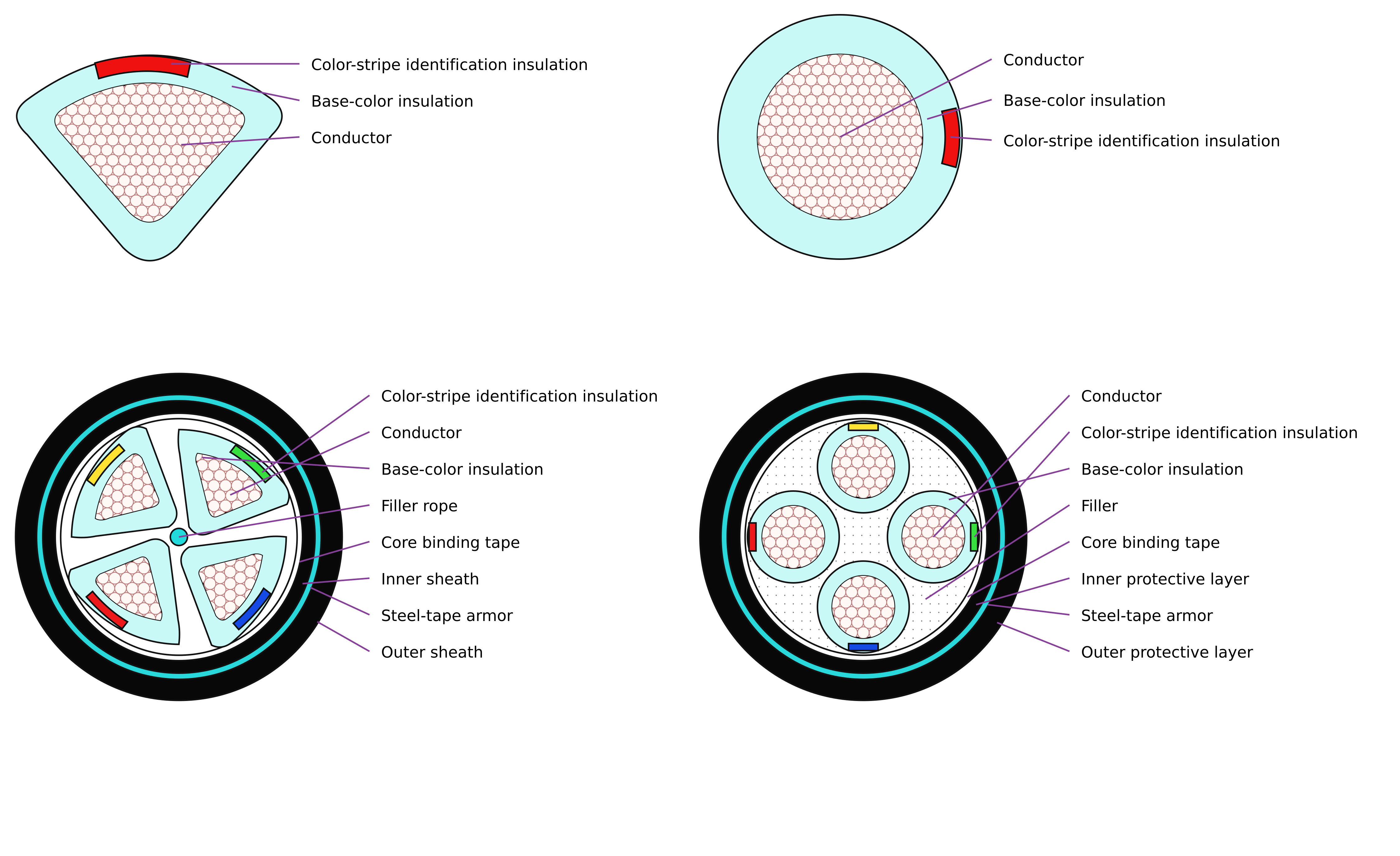
I. The Difference Between Wires and Cables
There is no strict dividing line between “wires” and “cables.”
Products with fewer cores, smaller diameters and simpler structures are usually called wires. Those without insulation are called bare wires, while the others are called cables.
Wires with larger conductor cross-sectional areas (greater than 6 mm²) are called large wires; those with smaller areas (less than or equal to 6 mm²) are called small wires. Insulated wires are also called wiring wires.
II. Different Cables
(1) Category: H — local communication cable; HP — distribution cable; HJ — exchange cable.
(2) Insulation: Y — solid polyolefin insulation; YF — foamed polyolefin insulation; YP — foam/solid-skin polyolefin insulation.
(3) Inner protective layer: A — polyethylene sheath with bonded plastic-coated aluminum-tape shielding; S — polyethylene sheath with double-layer aluminum and steel metallic-tape shielding; V — polyvinyl chloride sheath.
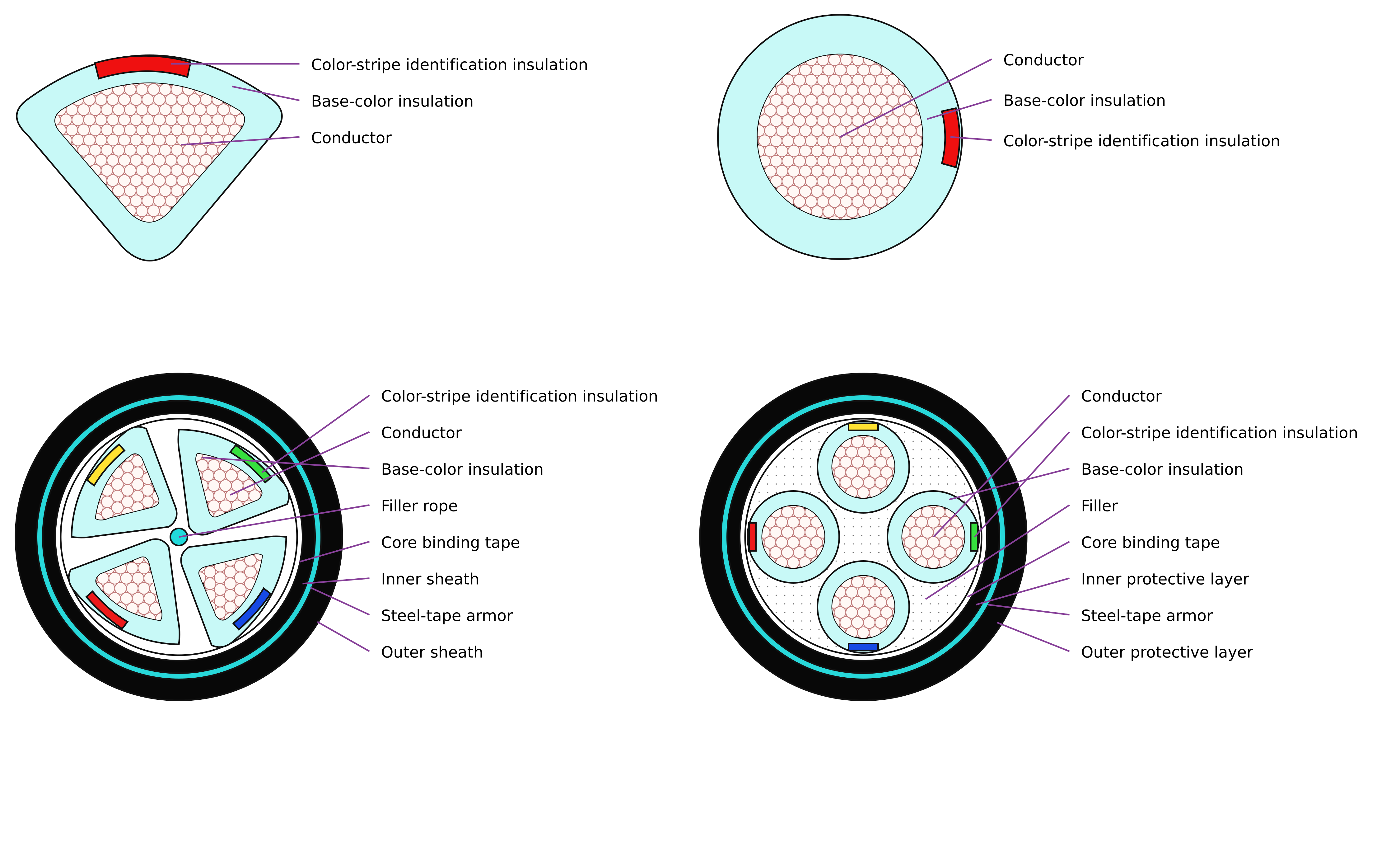
(4) Features: T — petroleum-jelly filled; G — high-frequency isolation; C — self-supporting.
(5) Outer protective layer: 23 — double-layer anticorrosion steel-tape wrapped armor with a polyethylene outer covering; 33 — single-layer fine steel-wire armor with a polyethylene covering; 43 — single-layer thick steel-wire armor with a polyethylene covering; 53 — single-layer corrugated steel-tape longitudinally wrapped armor with a polyethylene outer covering; 553 — double-layer corrugated steel-tape longitudinally wrapped armor with a polyethylene outer covering.
III. Cable Model Codes
1. Application code: no designation indicates a power cable; K indicates a control cable; P indicates a signal cable.
2. Insulation code: Z — oil-impregnated paper; X — rubber; V — polyvinyl chloride; YJ — cross-linked polyethylene.
3. Conductor material code: no designation indicates copper; L indicates aluminum.
4. Inner protective layer code: Q — lead covering; L — aluminum covering; H — rubber sheath; V — polyvinyl chloride sheath.
5. Derivative code: D — non-dripping; P — dry insulation.
6. Special product code: TH — humid tropical; TA — dry tropical.
7. Rated voltage: unit, kV.
IV. Cables for Different Applications
1. SYV: solid polyethylene-insulated radio-frequency coaxial cable.
2. SYWV(Y): physically foamed polyethylene-insulated cable for cable television systems; video (radio-frequency) coaxial cables (SYV, SYWV, SYFV) — suitable for closed-circuit surveillance and cable television projects.
SYWV(Y), SYKV — structure of cables specifically for cable television and broadband networks: (coaxial cable) a single oxygen-free round copper wire, physically foamed polyethylene (insulation), (tin wire), (aluminum), and polyvinyl chloride (polyethylene).
3. Signal control cables: (RVV sheathed wire, RVVP shielded wire) — suitable for building intercom, burglar alarm, fire protection, automatic meter-reading and other projects.
RVVP: copper-core, polyvinyl chloride-insulated, shielded, polyvinyl chloride-sheathed flexible cable. Voltage: 300 V/300 V; 2–24 cores — applications: installation of instruments, meters, intercom, surveillance and control systems.
4. RG: physically foamed polyethylene-insulated access-network cable — used to transmit data and analog signals in hybrid fiber-coaxial (HFC) networks.
5. KVVP: polyvinyl chloride-sheathed cable with braided shielding — applications: signal transmission, control and measurement for electrical appliances, instruments and power distribution equipment.
6. RVV: (227IEC52/53) polyvinyl chloride-insulated flexible cable — applications: household appliances, small power tools, instruments, and power and lighting.
7. AVVR: polyvinyl chloride-sheathed flexible cable for installation.
8. SBVV HYA: data communication cables (indoor and outdoor) — used for telephone communication, connection of radio equipment, and wiring of distribution boxes in telephone wiring networks.
9. RV, RVP: polyvinyl chloride-insulated cables.
10. RVS, RVB: cables suitable for connections in household appliances, small power tools, instruments, meters, and power and lighting.
11. BV, BVR: polyvinyl chloride-insulated cables — applications: suitable for fixed wiring in electrical appliances, instrumentation equipment, and power and lighting.
12. RIB: speaker connection wire (audiophile wire).
13. KVV: polyvinyl chloride-insulated control cable — applications: signal transmission, control and measurement for electrical appliances, instruments and power distribution equipment.
14. SFTP: twisted-pair cable for telephone, data and information-network transmission.
15. UL24 64: computer connection cable.
16. VGA: monitor cable.
17. SYV: coaxial cable for transmitting radio-frequency signals in wireless communication, broadcasting, surveillance-system projects and related electronic equipment (including general-purpose coaxial cables).
18. SDFAVP, SDFAVVP, SYFPY: coaxial cables specifically for elevators.
19. JVPV, JVPVP, JVVP: copper-core, polyvinyl chloride-insulated and sheathed computer control cables with copper-wire braiding.
Numeric Codes for Power Cable Armor and Outer Sheaths
0 — None;
1 — Interlocked armor; fibrous outer covering;
2 — Double-layer steel tape; polyvinyl chloride outer sheath;
3 — Fine round steel wire; polyethylene outer sheath;
4 — Thick round steel wire;
5 — Corrugated (embossed) steel tape;
6 — Double aluminum (or aluminum-alloy) tape;
7 — Copper-wire braid;
8 — Steel-wire braid.
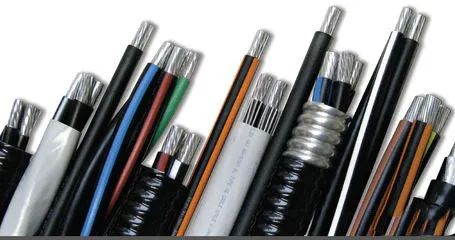
Classification of Wire and Cable Applications
1. Power Systems
Wire and cable products used in power systems mainly include overhead bare wires, busbars (bus conductors), power cables (plastic wires and cables, oil-paper power cables [largely replaced by plastic power cables], rubber-sheathed wires and cables, and overhead insulated cables), branch cables (replacing some busbars), magnet wires, and wires and cables for electrical equipment used in power installations.
2. Information Transmission Systems
These mainly include local telephone cables, television cables, electronic wires and cables, radio-frequency cables, fiber-optic cables, data cables, magnet wires, power-communication cables and other composite cables.
3. Machinery, Equipment and Instrumentation Systems
Almost all products other than overhead bare wires are used in this area, but the main ones are power cables, magnet wires, data cables, and instrumentation wires and cables.
Classification of Wire and Cable Products
1. Bare Wires and Bare Conductor Products
The main features of this category are pure conductor metal without insulation or sheath layers, such as aluminum conductor steel-reinforced stranded wires, copper and aluminum busbars, and electric locomotive wires. Processing mainly involves pressure working, such as melting, rolling, drawing, and stranding/compacted stranding. These products are mainly used in suburban areas, rural areas, users’ main supply lines, switchgear and similar applications.
2. Power Cables
The main features of this category are an insulation layer extruded (or wrapped) around the conductor, as in overhead insulated cables; or several cores stranded together (corresponding to the phase, neutral and earth conductors in a power system), as in overhead insulated cables with two or more cores; or an additional sheath layer, as in plastic/rubber-sheathed wires and cables.
The main processing techniques include drawing, stranding, insulation extrusion (wrapping), cabling, armoring and protective-layer extrusion. The combinations of processes differ to some extent among products.
These products are mainly used to transmit electrical energy at high power in generation, distribution, transmission, transformation and supply lines, carrying large currents (tens to thousands of amperes) at high voltages (220 V to 500 kV and above).
3. Wires and Cables for Electrical Equipment
The main features of this category are a wide variety of types and specifications, a broad range of applications, and operating voltages most commonly at 1 kV and below. New products are continually developed for special applications, such as fire-resistant cables, flame-retardant cables, low-smoke halogen-free/low-smoke low-halogen cables, termite-resistant and rodent-resistant cables, oil-resistant/cold-resistant/temperature-resistant/abrasion-resistant cables, medical/agricultural/mining cables, and thin-wall wires.
4. Communication Cables and Optical Fibers
These have developed from the simple telephone and telegraph cables of the past into telephone cables with thousands of pairs, coaxial cables, fiber-optic cables, data cables and even combined communication cables. These products usually have small, uniform structural dimensions and require high manufacturing precision.
5. Magnet Wires (Winding Wires)
Mainly used in various motors, instruments, meters and similar equipment.
Wire and Cable Specifications and Model Designations
RY — Polyethylene-insulated flexible wire
BV — Copper-core polyvinyl chloride-insulated wire
RV — Copper-core polyvinyl chloride-insulated flexible installation wire
RV — Copper-core vinyl chloride-insulated connection cable (wire)
BLV — Aluminum-core polyvinyl chloride-insulated wire
BYR — Polyethylene-insulated flexible wire
BVR — Copper-core polyvinyl chloride-insulated flexible wire
BVS — Copper-core polyvinyl chloride-insulated twisted flexible wire
RVB — Copper-core polyvinyl chloride-insulated flat flexible connection wire
RYV — Polyethylene-insulated polyvinyl chloride-sheathed flexible wire
BYVR — Polyethylene-insulated polyvinyl chloride-sheathed flexible wire
BVV — Copper-core polyvinyl chloride-insulated polyvinyl chloride-sheathed wire
BLVV — Aluminum-core polyvinyl chloride-insulated polyvinyl chloride-sheathed wire;
AVR — Tinned copper-core polyethylene-insulated flat flexible connection cable (wire)
RVB — Copper-core polyvinyl chloride flat connection wire
RVS — Copper-core polyvinyl chloride twisted connection wire
RVV — Copper-core polyvinyl chloride-insulated polyvinyl chloride-sheathed round flexible connection cable
ARVV — Tinned copper-core polyvinyl chloride-insulated polyvinyl chloride-sheathed flat flexible connection cable
RVVB — Copper-core polyvinyl chloride-insulated polyvinyl chloride-sheathed flat flexible connection cable
Meaning of Wire and Cable Specification Notation
Specifications are expressed by the number of cores, nominal cross-sectional area and voltage rating.
1. Specification notation for single-core branch cables: number of cables in the same circuit × (1 × nominal cross-sectional area), 0.6/1 kV.
For example: 4*(1*185)+1*95 0.6/1KV
2. Specification notation for multicore stranded branch cables: number of cables in the same circuit × nominal cross-sectional area, 0.6/1 kV.
For example: 4**185+1*95 0.6/1KV
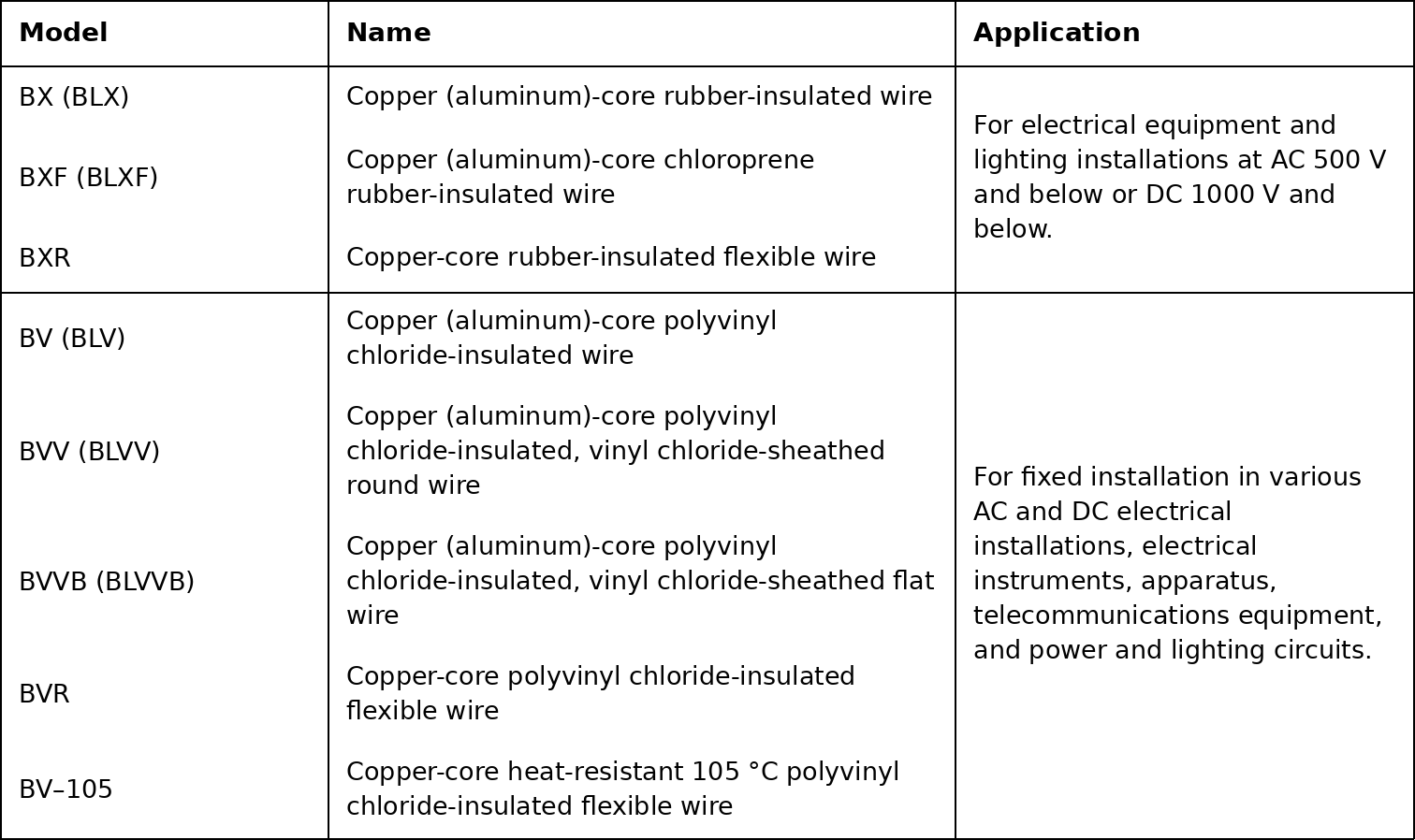
Explanation of Wire and Cable Specifications and Model Designations:

Notes:
B (B) — The first letter indicates wiring; the second indicates glass-fiber braiding.
V (V) — The first letter indicates polyethylene (plastic) insulation; the second indicates a polyethylene sheath.
L (L) — Aluminum; the absence of L indicates copper.
F (F) — Composite type.
R — Flexible wire.
S — Twisted pair.
X — Insulating rubber.