
What "Class A" actually tells you about a flame retardant cable
A flame retardant class A cable is a cable whose flame spread performance has been classified at the highest class level within the classification scheme the supplier cites. The label describes how the cable behaves when exposed to fire — specifically, how far flame propagates along a bundled or vertically mounted cable under defined test conditions — not how long the cable keeps working during a fire.
That distinction is the single most common source of specification error. Buyers searching for "class A cable" sometimes need a cable that resists flame spread, and sometimes need a circuit that stays live during a fire. These are different properties, tested differently, and frequently combined in one product. Before comparing suppliers, decide which of the two your project actually requires, or whether it requires both.
One caution on terminology: "class A" is not a single global definition. Different standards and regions define flame spread classes with their own letters, test rigs, and acceptance criteria. A class A claim is only meaningful when it names the standard, the test method, and the classification table it refers to. Ask for that reference in writing rather than accepting the class letter alone.
Flame retardance versus fire resistance: the decision that shapes your specification
Flame retardance limits fire growth. A flame retardant cable is designed not to propagate flame along its length, so a local fault or an adjacent fire does not turn the cable run into a fuse. Fire resistance is a survival property: the cable continues to transmit power or signal for a defined period while exposed to fire, so downstream equipment keeps operating.
Most serious building and industrial specifications need both, and the two requirements are written as separate clauses. A cable can be flame retardant without being fire resistant, and fire-resistant constructions normally also carry flame retardant performance. When you see a product described as "flame-retardant class A fire-resistant," that phrasing usually signals two distinct claims stacked together — verify each one separately.
| Property | What it answers | Typical evidence to request | Where it matters |
|---|---|---|---|
| Flame retardance (class A) | Will flame spread along the cable run? | Flame spread test report citing the standard, class, and test conditions | Riser shafts, cable trays, bundled runs, tunnels |
| Fire resistance | Will the circuit keep working during a fire, and for how long? | Fire resistance test report stating the rating period and test method | Fire alarm, smoke extraction, emergency shutdown, evacuation systems |
| Low smoke zero halogen (LSZH) | What does the cable emit when it burns? | Smoke density and halogen content test data | Enclosed spaces, occupied buildings, areas with sensitive equipment |
The third row is often the one that decides a project. In a basement plant room, a tunnel, or a crowded public building, the limiting hazard is frequently smoke and corrosive gas rather than flame travel. LSZH performance protects people trying to evacuate and protects electronics that would otherwise be damaged by acidic combustion products.
Reading a WDZAN designation without guessing
Chinese cable model designations are compact, and each letter carries a meaning. In WDZAN constructions, the letters indicate a low-smoke, halogen-free, flame retardant cable with class A flame spread performance and fire resistance. The suffix letters after the hyphen describe the cable's construction and conductor type.
For control and instrumentation circuits, three constructions cover most of the demand:
- WDZAN-KYY — a fire-resistant control cable with stranded conductors, used for control, signal, and monitoring circuits that must remain operational under fire conditions. Core counts run up to 61, which matters when a single multicore run replaces several smaller cables.
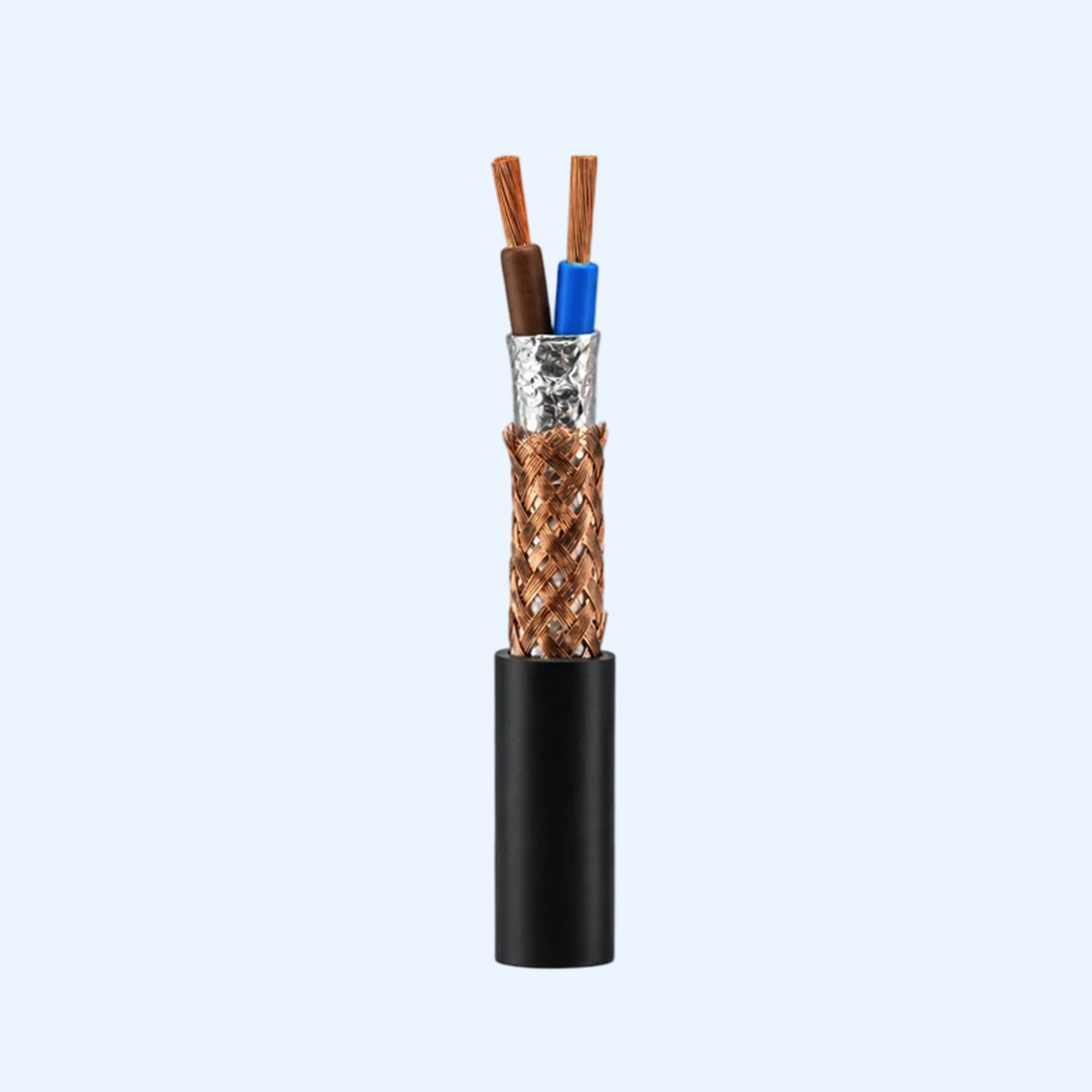
- WDZAN-KYYP — the same construction with a copper wire braid screen, for circuits where electromagnetic interference would corrupt the signal. Screening and fire resistance are separate requirements; confirm both appear in the test documentation.
- WDZAN-KYYR — a flexible-conductor version for installations that need easier routing and bending, such as confined spaces, cable trays, and equipment connections.
None of these designations tells you the conductor size, voltage rating, or temperature rating on its own. Those are separate line items in the datasheet, and they must match your circuit design and installation environment.
Where class A flame retardant control cable earns its cost
Class A flame spread performance is most valuable where cables are installed in bundles or vertical runs. In a single isolated cable, flame propagation has limited fuel to work with. In a tray carrying dozens of cables, one burning cable can preheat and ignite its neighbours, and the fire climbs. This is why the classification scheme and the installation method are linked: a test performed on a bundled or vertical arrangement is more relevant to a riser or a dense tray than a test on a single horizontal sample.
Match the specification to the physical installation:
- Vertical shafts and risers: prioritise flame spread class and confirm the test arrangement resembles your installation.
- Dense horizontal trays: bundled test evidence is more informative than single-cable data.
- Life-safety circuits: add fire resistance with a stated duration, and confirm the duration covers the evacuation or shutdown sequence the system is designed for.
- Instrumentation and control panels: add screening where variable-frequency drives, relays, or nearby power cables create interference.
A practical rule: the more cables share a route and the harder that route is to inspect after a fire, the more the flame spread class matters relative to unit price.
Questions to put to a supplier before you approve the cable
Supplier evaluation is where most of the risk sits, because the class letter is easy to print and harder to substantiate. Ask these questions in writing and require documentary answers:
- Which standard and which class table does the flame retardant class A claim refer to? Request the test report, not a certificate summary.
- Which test method supports the fire resistance claim, and what duration is stated? Is the report for this exact construction or for a family of similar products?
- What smoke density and halogen content data exist for the compound used in this construction?
- For the screened version, what braid coverage and screen construction are specified, and does the screening appear in the same tested construction as the fire performance?
- Which conductor sizes and core counts are available in each construction, and does the maximum core count apply to every size?
- Can the datasheet state conductor material, insulation compound, sheath compound, voltage rating, and temperature rating explicitly rather than by implication?
- What marking appears on the cable and on the drum, and does it match the designation on the datasheet?
If a supplier answers these with brochures instead of documents, treat that as a signal about how the next technical question will be handled.
Sample and delivery validation: what to check and when
Documentation review catches specification errors; physical checks catch manufacturing and handling errors. Both belong in the approval process, and the checks differ by stage.
Before order placement
- Compare the datasheet against your specification clause by clause, including the standard references behind each performance claim.
- Request a sample of the exact construction, not a similar model, and inspect sheath concentricity, print legibility, and conductor stranding.
- For flexible versions, bend the sample through the tightest radius your route requires and check that the sheath does not wrinkle or separate.
At goods receipt
- Check drum and cable marking against the purchase order designation, core count, and conductor size.
- Measure conductor dimensions on a short cut length and compare with the declared cross-section.
- Inspect for sheath damage, water ingress at the ends, and correct end sealing on drums that have travelled.
- Retain a cut sample from each delivery batch so that any later dispute can be resolved against the actual material supplied.
These checks are inexpensive relative to the cost of removing and replacing a cable run inside a finished riser.
Warning signs in a class A flame retardant cable offer
Several patterns recur in offers that look compliant on paper. None of them proves a problem on its own, but each deserves a direct question.
- The class letter appears without a standard reference, test method, or report number.
- Fire resistance is claimed as a property of the material rather than as a tested construction with a stated duration.
- The screened and unscreened versions share a single test report without clarifying which construction was tested.
- Core count and conductor size ranges are quoted as a headline maximum without a per-size availability table.
- LSZH is asserted but no smoke density or halogen content data is offered.
- The datasheet omits voltage rating or temperature rating, leaving the buyer to infer them.
Any one of these can be resolved with a document. A supplier who cannot resolve them is asking you to carry the technical risk.
Next steps for a procurement decision
Write the specification in three layers: the flame spread class with its standard reference, the fire resistance requirement with its duration and test method, and the emission requirement (LSZH) with its supporting data. Then add the construction details — core count, conductor size, screening, flexibility — as separate line items. This structure makes it obvious when a supplier has answered only part of the requirement, and it gives your own inspection team something concrete to check at goods receipt.
Where a single multicore control cable can replace several smaller runs, confirm the maximum core count for the specific conductor size you need before designing the route around it. And keep the test reports with the purchase file: in a dispute, the report that mattered is the one that named the construction you actually received.